Wheat Field Playgrounds
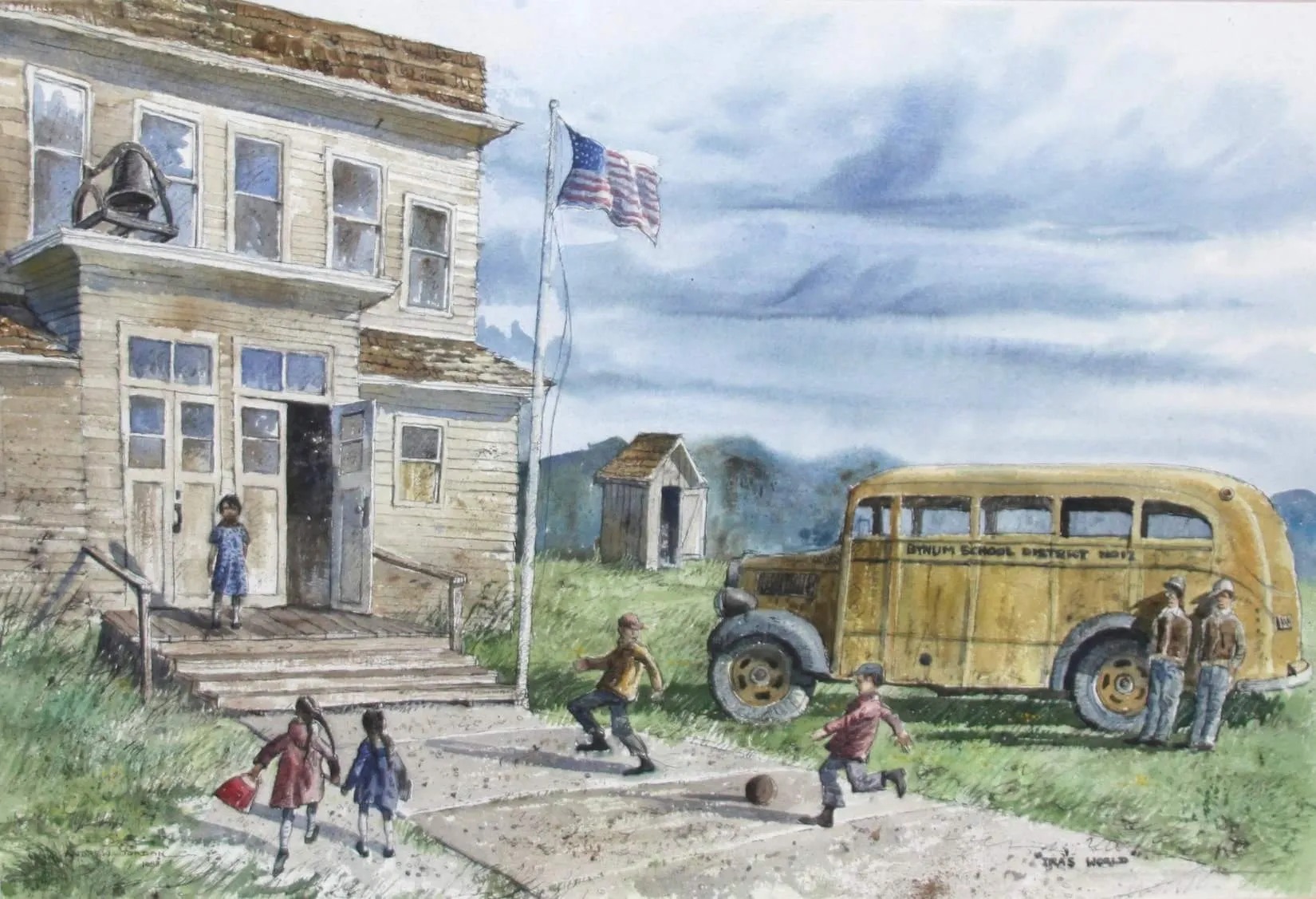
Somewhere between the wheat and the Rocky Mountains, there sits a little town called Bynum, with a population of about 25, but really, who has been there recently to gather a more accurate census? We can’t be sure. In that little town, there was a bar, a dinosaur museum, and an old schoolhouse.
Blue with a big bell hanging above the front door, it was two classrooms, one upstairs, one downstairs, and a “band room” which was really just a room stacked to the ceiling with books and dusty cases of musical instruments, which probably sounded just as good as they did twenty years before. Two teachers manned the classrooms, one for kindergarten through fourth grade, and the other for fifth through eighth.
Friday was PE day. On most occasions, the whole 20 of us students would walk across the parking lot to the old church, which had a basketball court floor, and pews stacked on the stage to allow for games to be played. But seldom did we play basketball. More often, the teacher would pull out the record player, and we would learn to dance to vinyl records. I owe my ability to fox trot to Brenda Lee’s “Rockin’ Around the Christmas Tree”. From the waltz to the 2-step to a good-old fashioned Polka, we learned to dance the old way.
When I was in the second grade, the school was given a handful of violins. It was obligatory that each of us learned to play. Throughout those years, I learned to play a plethora of instruments beyond violin, like guitar, piano, mandolin, African drums, and the trombone. I also got my start reading and writing music, playing music by ear, and singing. My love for music began there and never stopped.
Every year, the music and dancing culminated into a grand Christmas program. Included were the skits and plays the students wrote themselves, with the help of the teachers. The old church transformed into a standing-room-only showhouse, and a handful of farmers’ kids seemed to have been plucked straight from Broadway itself. Everyone sang, everyone wore costumes, everyone danced. No exceptions.
Aside from the arts, we were an athletic bunch as well. Every year, we had two track meets. These were held at neighboring, similarly small and rural, schools and also welcomed homeschooled children. The races were run in a grass field, with some students opting to compete in their socks. It should come as no surprise that these students usually won. I can’t decide if my competitive edge was always inherent, or if those middle-of-the-field track meets lit the spark of a lifelong competitive edge.
There must have been a bit of magic sprinkled out there among the dust in the field we called the playground, because a textbook couldn’t have taught us what we learned there. Nothing could have shaped us the way dancing on wooden floors and running on grass runways did. No amount of technology could have given us a glimpse into the life we observed on creek bottoms and river beds. No documentary could have told us how the old ranchers lived; instead, we’d load up on the bus and feed cows with the teacher’s husband on a random Wednesday.
For the first time in over 100 years, Bynum school isn’t opening this year due to low enrollment. It’s the sort of calamity which feels personal, driven by tenderness and nostalgia towards what I had, something I wish so many more were fortunate enough to experience. The adventure, the rooted well-roundedness of the education. But perhaps this is the beauty of it; that not everyone could experience it. It remains extraordinary due in part to its exclusivity. Places such as these are disappearing quickly, and with them, the roots of rural childhoods, and the lost art of learning from tradition.
I see it now: how Bynum school shaped so many loves in my life, from songwriting, to acting, to sports. The most notable effect the place had upon me was the conception of an imagination. I’ve long believed God’s greatest gift to man is the creative mind, but it must be nurtured at a young age in order for it to fully flourish. Mine was certainly nurtured there. It’s a special thing to discover the imagination. It’s even more special to realize it never goes away once you’ve found it. I found mine in the wheatfield playgrounds next to the blue Bynum schoolhouse.
-Paige Rasmussen
Post a comment